The first annual parapet inspection report must be completed by December 31st, 2024
New York City has enacted a new life safety law requiring annual inspection of parapets. All building owners need to be aware of the regulations and schedule their parapet inspection. Beginning January 1, 2024, annual parapet inspections are required for all New York City buildings with parapet walls that front the public right-of-way, with specific exemptions. The first annual parapet inspection report must be completed by December 31st, 2024. The building’s owner must keep a copy of each report for at least six years and make it available to the NYC Department of Buildings (DOB) upon request to remain in compliance. These inspections are a critical part of maintaining safe architecture in Manhattan and protecting New Yorkers who walk near and around these buildings on a daily basis.
What are parapets, and why are they subject to annual inspections?
Parapets are parts of walls that extend above the building’s roof line, commonly referred to as parapet walls. Due to their exposure to the elements, parapets can deteriorate over time and pose serious risks to public safety. These conditions necessitate preventive maintenance and regular observation. As rooftop elements, parapets often collect debris and can directly impact adjacent facades if not properly maintained. Parapets are to be included in the inspection even when they are party walls shared between adjacent properties. Parapets above balconies do not need to be inspected, as they are not located above the roofline. Decorative elements such as cornices only need to be inspected if they are attached to a parapet. This is especially important in buildings with historic preservation status, such as brownstones, where architectural details must be maintained with additional care.
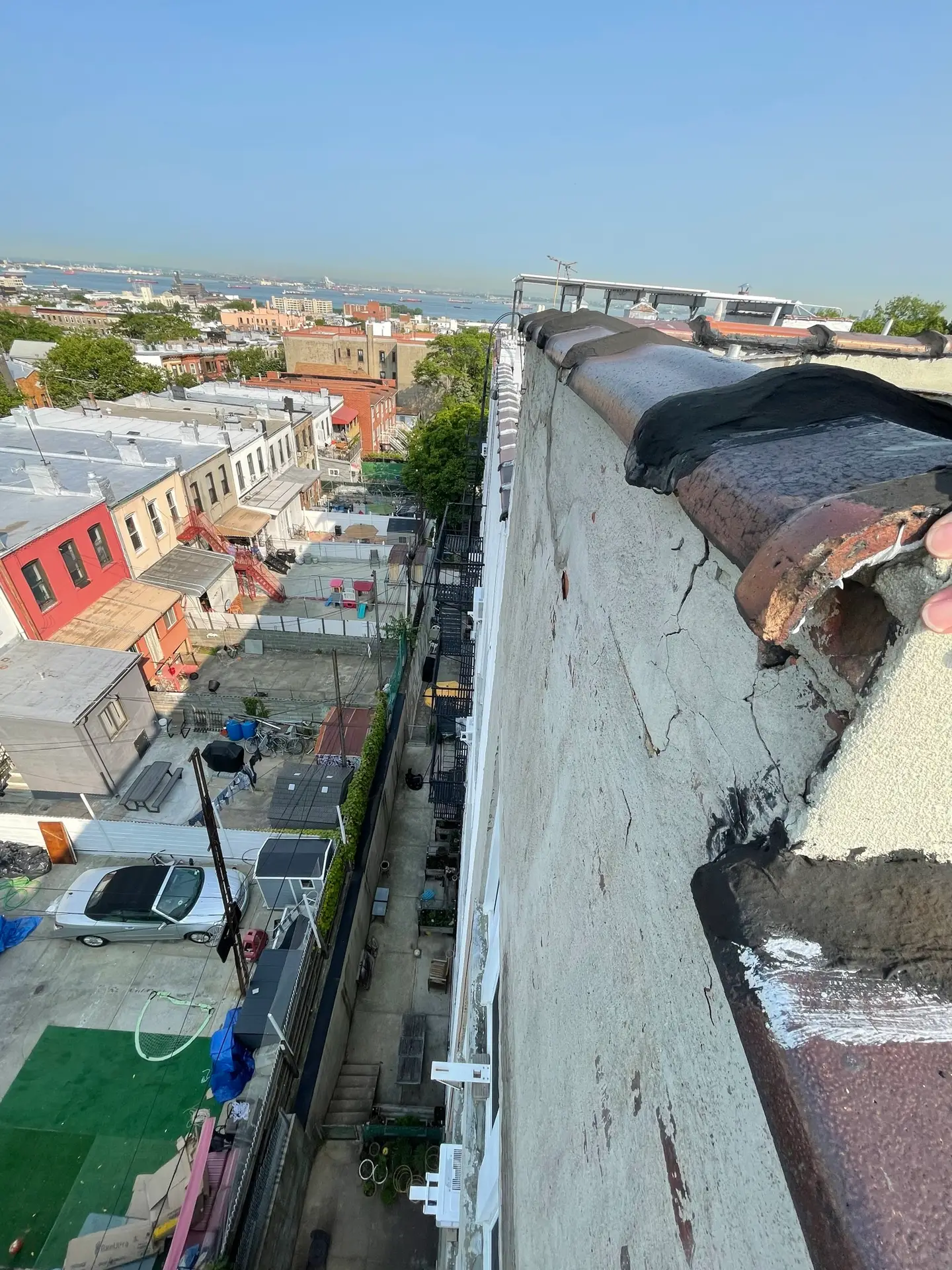
A deteriorated parapet with weathered brick, displaced copings, and a step crack in the mortar
What is the public right-of-way?
The “public right-of-way” is anywhere that a member of the public can walk freely, including on private property. An exterior wall fronts the public right-of-way, allowing members of the public to approach it. If a building’s parapet fronts the public right-of-way, the entire parapet must be inspected, including at walls that do not front a public right-of-way. Property owners must ensure compliance with these rules to avoid violations. Ensuring safety in the public right-of-way is one of the primary goals of this new inspection rule.
What buildings are exempt from this rule?
- Detached buildings that are one or two-family homes are exempt from this rule, even if they have parapets that front the public right-of-way.
- Buildings without parapets that front the public right-of-way are also exempt, even if they have other, non-street-facing parapets.
- Buildings with an uninterrupted barrier or fence that sits less than half the height of the exterior wall must be inspected. For example, if a one-story building is 14 feet tall and has a continuous barrier 7 feet or more from the facade, it would be exempt from the rule.
- The exemption criteria apply regardless of whether the structure is a condo or a single-family residence.
These exemptions are based on current New York City regulations. Failure to comply with the exemption criteria may result in penalties.
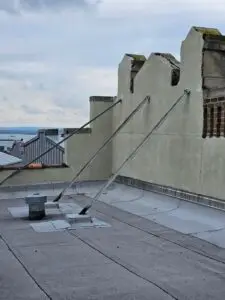
Inboard side of a parapet
What is included in a parapet inspection?
The qualified inspector, often a licensed engineer, will conduct a thorough observation and assessment of several engineering-related criteria:
- Plumbness: Determine if a parapet is plumb by a horizontal distance within 1/8 of its cross-sectional thickness in any location.
- Deterioration: Determine if the parapet is free from excessive decline, including, but not limited to: displacement, horizontal or diagonal cracks, missing or loose bricks or coping stones, deteriorated mortar joints, spalling, or rot.
- Appurtenances: Determine if cornices, telecommunications equipment, railings, roof access rails, gooseneck ladders, and handrail attachments for fire escapes, signs, and other items that are supported or attached to a parapet wall have been installed and maintained in a stable condition.
- Inspectors should also assess the integrity of waterproofing, especially in older buildings such as brownstones, where poor waterproofing can accelerate facade deterioration. Property management teams must prioritize such evaluations to ensure long-term safety and compliance.
The qualified inspector will submit a written inspection report to the owner, which will include a detailed description and photographs of the observed conditions. The findings must be classified as safe, unsafe, or safe with a repair or maintenance plan (SWARMP). These inspections are also aligned with facade safety protocols and are vital in protecting both structural integrity and architectural heritage.
What if a parapet is observed to be unsafe or requires maintenance?
All unsafe conditions must be remedied within ninety days. There are no extensions to this rule. The inspector must notify the Department of Buildings (DOB) immediately by calling 311 and emailing parapets@buildings.nyc.gov. The owner must install public protection such as sidewalk sheds, safety nettings, or fencing. The public protection must remain in place until the unsafe condition is completely remedied. If the building is subject to FISP, an unsafe notification (FISP3) must be filed with the DOB. While some situations may not be inherently dangerous, they may still require a repair or maintenance plan and must be reported as “SWARMP.” There is no time limit to remedy these conditions, and the qualified inspector does not need to notify the DOB. Instead, the qualified inspector must include a plan for preventive maintenance in the report, with status updates in each following report. Responding swiftly to emergency safety issues can significantly reduce overall cost and preserve the owner’s investment.
Do buildings require parapet inspections if a FISP report was filed in the same year?
The new parapet inspection rule is not directly related to the Façade Inspection & Safety Program (FISP). Parapet inspections must be conducted annually, while FISP reports occur every five years on a cyclical basis. If a building has filed a FISP report that fulfills all of the parapet inspection criteria, a separate inspection is not required that year. For additional guidance or comparison, owners may review case studies from firms like Hoffmann Architects or seek expertise from institutions such as the New York Landmarks Conservancy, known for supporting historic building preservation and facade safety in New York.
Contact Us Today
At Henson, we take pride in our expertise when it comes to inspecting buildings and preparing maintenance plans. If you have any questions or would like to schedule your next parapet inspection, contact us at (212) 995-2464 or info@hensonarchitect.com.